

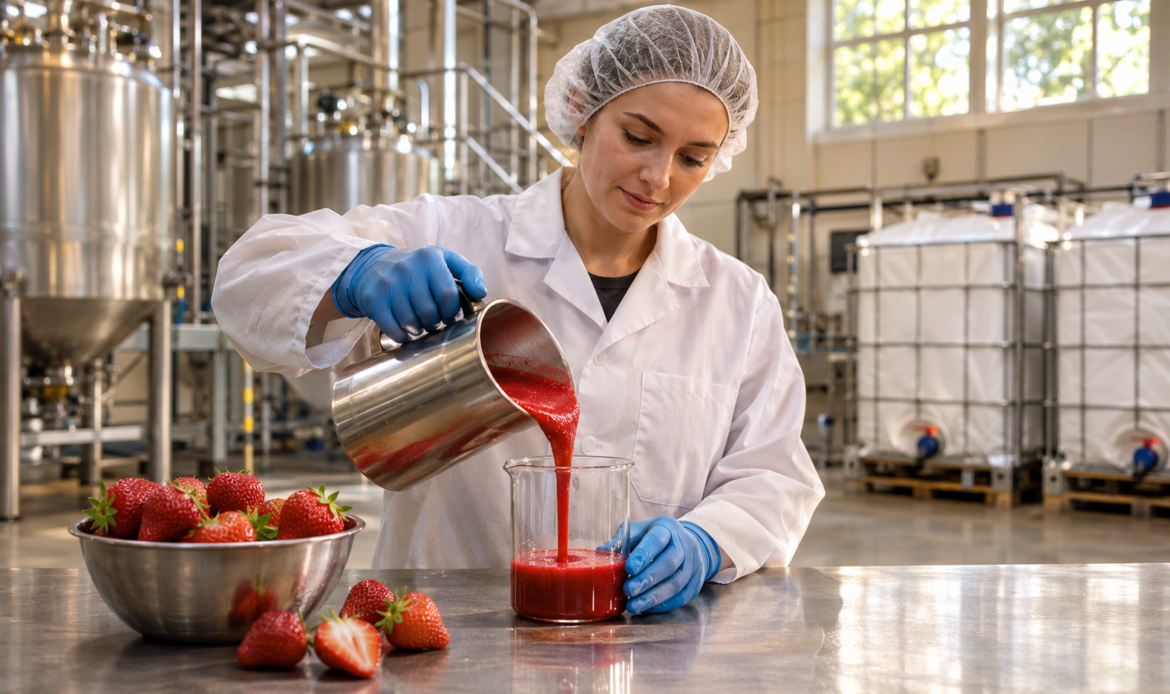
Aseptic fruit purees are fruit purees that have been heat-treated, cooled, and sealed into sterile packaging, so they stay shelf-stable at room temperature without freezing. Food manufacturers use them in bakery fillings, fruit bars, beverages, sauces, and dairy because they pour straight from the bag, hold a consistent spec from lot to lot, and can sit in a dry warehouse instead of a freezer. For a buyer, the tradeoff is fairly simple. You give up a little of the bright color and aroma that frozen puree keeps, and in return you get easier storage, easier handling, and a supply chain with fewer ways to fail.
How are aseptic fruit purees made?
Aseptic puree is made by pulping fresh fruit, flash-heating it for a few seconds up to about a minute, cooling it, and filling it into a pre-sterilized bag inside a sealed chamber. The word “aseptic” means free of contaminating microorganisms, and it applies to the product and the package at the same time.
The heat step has two jobs. It kills spoilage organisms, and it shuts down the natural fruit enzymes that would otherwise break down texture and color over time. High-acid fruits such as apples, pears, and berries need a gentler treatment than low-acid fruits like banana, which is one reason berry purees tend to keep their flavor well in aseptic form.
After filling, the bag stays sealed until it reaches your line. Nothing touches open air between the sterilizer and the moment your team opens the valve.
How is aseptic puree different from frozen puree?
The biggest difference is storage. Aseptic puree sits on a shelf at room temperature, while frozen puree has to stay at 0°F or colder from the processor all the way to your plant.
That one difference changes a lot of the math. Cold storage commonly costs two to three times as much per pallet as dry storage, and refrigerated freight runs well above dry freight. Frozen puree also has to be thawed under control before use, often 12 to 24 hours in a cooler, which ties up space and adds a planning step. Aseptic puree can be pumped or poured the day it arrives.
Aseptic puree often carries a higher price per pound than frozen. Once storage, freight, and thawing are added in, the total cost can come out even or lower, so it’s worth comparing on a delivered and stored basis rather than unit price alone.
When does frozen puree make more sense?
Frozen puree is usually the better choice when fresh color and aroma are the whole point of the product. Premium ice cream, some dairy applications, and raw-packed berry products can benefit from the brighter fruit character that freezing preserves. Aseptic puree can carry a slight cooked note, which most bakery and bar applications never notice but a delicate dairy dessert might.
How long do aseptic fruit purees last?
Unopened aseptic puree typically lasts 12 to 24 months when stored at room temperature, ideally below about 75°F and away from direct heat. The exact shelf life depends on the fruit and the package, so the supplier’s spec sheet is the number to plan around.
Once a bag is opened, treat it like fresh product. Most opened aseptic puree should be refrigerated and used within about five days. Some manufacturers refreeze opened product to stretch it further, though texture and color can shift.
Heat is the main thing that shortens shelf life. A warm warehouse can darken color and dull flavor well before the expiration date, so first-in, first-out rotation and a cool storage area matter more than most buyers expect.
What packaging sizes does aseptic puree come in?
Most aseptic puree ships in a format sized to how fast a plant uses it. Common options include:
- Bag-in-box cases, usually from about 1 to 25 liters, for smaller runs and R&D
- Bag-in-drum, typically a liner inside a 55-gallon steel or fiber drum
- Bag-in-tote, in large bins of about 1,000 liters or more for high-volume lines
The right size depends less on price per pound and more on how quickly you can finish an opened container. A drum you can’t use within a few days of opening isn’t a bargain.
How do food manufacturers use aseptic puree?
Manufacturers use aseptic puree anywhere they want real fruit flavor, color, and moisture in a form that pumps and measures easily. The puree’s consistency from lot to lot is a big part of the appeal, especially at scale.
How is fruit puree used in bakery?
In bakery, puree goes into fillings, batters, glazes, and icings. Apple puree is a long-standing tool for replacing part of the fat or sugar in muffins and quick breads, and berry purees add color and flavor to fillings. Fillings usually need a starch or pectin system for bake stability, so the puree spec and the filling formula should be developed together. See our Bakery applications page for more.
How is fruit puree used in bars and snacks?
Puree works as both a flavor source and a binder in fruit bars, fruit snacks, and fruit leathers. Because bars are sensitive to moisture, formulators often pair puree with low-moisture ingredients like apple powder or infused fruit pieces to keep water activity where it needs to be. Our Bars applications page covers the ingredients that work well together.
How is fruit puree used in beverages and dairy?
Smoothies, ready-to-drink beverages, kombucha, and craft beer all use aseptic puree, since it blends easily and needs no thawing. In dairy, purees go into yogurt fruit preparations and flavored milks, and they’re common in sauces, dressings, and glazes on the savory side.
What should you check on an aseptic puree spec sheet?
Start with Brix and pH, since those two numbers tell you how sweet and how acidic the puree is and how it will behave in your formula. From there, a complete spec sheet should cover:
- Brix (soluble solids) and acidity
- Consistency or viscosity, often measured with a Bostwick reading
- Screen size, which tells you whether seeds have been removed from raspberry and blackberry purees
- Color standards and any allowed variation
- Microbiological limits and commercial sterility testing
- Shelf life and storage conditions
- Food safety certification, organic certification if you need it, and allergen statements
If any of these are missing, ask for them before the first order. A supplier who can hand you complete documentation up front will likely be easier to work with when you’re scaling up.
Which fruits are available as puree?
Most common fruits are available as puree, including apple, pear, strawberry, raspberry, blackberry, blueberry, mango, peach, and banana. Berry and orchard fruits are the most widely used in North American bakery and bar production.
Unique Ingredients supplies apple, pear, blueberry, raspberry, strawberry, and blackberry purees, with organic options available. You can see the full line on our Fruit Purees page.
Why does supplier location matter for a puree program?
Supplier location matters because aseptic puree doesn’t need a freezer, so it can be held in regional warehouses close to your plant. That shortens lead times and takes ocean freight delays out of your production schedule.
Unique Ingredients keeps inventory in regional warehouses near major manufacturing markets, and most orders arrive in one to two days. Before we buy from any source, our quality team is on site in the facility. You can read more about our Regional Warehousing and Quality Assurance approach.
If you’re comparing purees for a new product or a reformulation, talk to our team about samples and spec sheets.
Frequently asked questions
Do aseptic fruit purees contain preservatives?
Most do not. The heat treatment and sterile packaging do the preserving, so many aseptic purees list only fruit on the ingredient statement. Check the spec sheet for any added acids or ascorbic acid, which are sometimes used to protect color.
Is fruit puree the same as fruit juice concentrate?
No. Puree keeps the fruit’s pulp and fiber, while juice concentrate is filtered juice with most of the water removed. Concentrate is much sweeter by weight, often 60 to 70 Brix, and it’s used more as a sweetener and flavor than as a fruit base.
Can aseptic puree be stored in a cooler instead of a dry warehouse?
Yes. Unopened aseptic puree doesn’t need refrigeration, but a cool storage area helps protect color and flavor. Avoid freezing unopened bags unless the supplier says it’s acceptable for that product.
Is organic aseptic puree available?
Yes, many fruits are available as certified organic puree. The organic certification needs to cover every step from the grower to the packer, so ask for the certificate along with the spec sheet.
How fast can I get a sample?
Unique Ingredients ships samples from regional warehouse stock, so most arrive within days. Contact our team with the fruit and the application you’re working on.