
Before buying bulk dried fruit for food manufacturing, ask a supplier for complete spec sheets, food safety documentation, realistic lead times, and a clear answer on how they’ll keep you supplied in a short crop year. Price matters, but the expensive problems with dried fruit usually come from somewhere else: a lot that drifts out of spec, paperwork that holds up approval, or an order that arrives two weeks late and stops a production line. The questions below help you compare suppliers on the things that actually cause trouble, so the first order goes smoothly and the hundredth does too.
What product specs should you ask for?
Ask for a full specification sheet for every fruit and cut you plan to buy. At minimum, it should list moisture, water activity, cut size, color, defect limits, and ingredients, including any infusion syrup, oil coating, or processing aids.
Those numbers matter because they decide how the fruit behaves in your product. Moisture and water activity affect texture and shelf life. Cut size affects distribution and how the fruit runs through your equipment. Defect limits tell you how many stems, pits, or off-color pieces you can expect. If a supplier’s spec sheet is vague or missing ranges, that’s a sign you’ll have trouble holding them to a standard later.
What food safety documents should a supplier provide?
A dried fruit supplier should be able to send a complete documentation package before your first order. That usually includes:
- Current food safety certification, such as a GFSI-benchmarked scheme like SQF or BRCGS
- A certificate of analysis for each lot, showing the lot met spec
- Allergen statements and information on cross-contact risk
- Traceability and recall procedures
- Organic, kosher, or other certificates if your label requires them
- Insurance certificates and any supplier questionnaires your company uses
If you have to chase each document separately, approval will take longer, and you’ll likely have the same problem every time a certificate expires. Ask whether the supplier can hand you the full packet at once.
How do you check quality before the first order?
Request samples and test them in your own formula on your own equipment. A sample tells you how the fruit tastes, how it looks, and how it holds up in mixing, baking, or extrusion. Compare it against your current ingredient if you’re switching.
It’s also fair to ask how the supplier checks its own sources. Some buy based on paperwork alone. Others send their own people to the processing facility. Unique Ingredients’ quality team is on site, in the facility, before we buy from any source, so we’ve seen the operation behind every product we sell. You can read more on our Quality Assurance page.
What lead times should you expect for bulk dried fruit?
Lead times range from a day or two to several weeks, depending on where the supplier keeps inventory. A supplier shipping from a single plant or bringing product in by ocean freight will have longer, less predictable lead times than one holding stock near you.
Ask these questions directly:
- Where is the inventory for my order held today?
- What’s the typical time from order to delivery at my plant?
- What’s the minimum order quantity, and what pack sizes are available?
- Can you hold safety stock for me or schedule regular releases?
Unique Ingredients keeps dried fruit in regional warehouses near major manufacturing markets, so most orders arrive in one to two days. Our Regional Warehousing page has more detail.
What should you ask about packaging and storage?
Ask how the fruit is packed, how it should be stored, and what shelf life you can expect under your plant’s conditions. Packaging affects how much product you have to open at once, how easily it moves through your plant, and how well it holds up in storage.
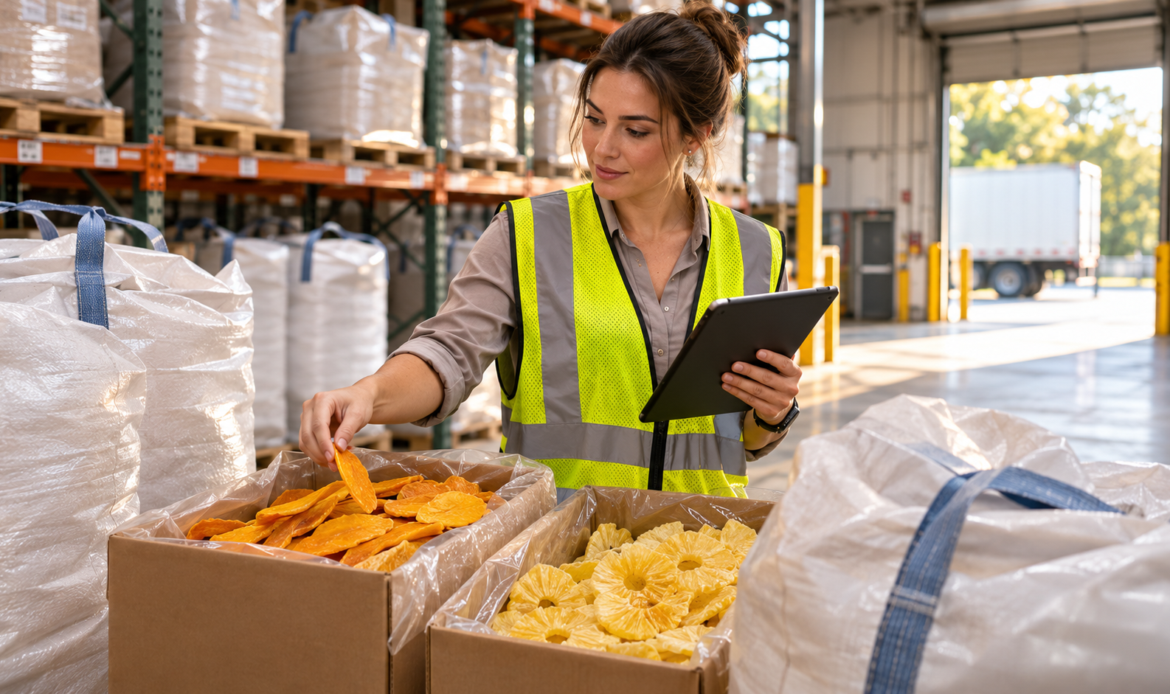
Most manufacturing-grade dried fruit ships in poly-lined cardboard cases on pallets. Some suppliers offer larger totes for high-volume lines, and some offer smaller packs for R&D and pilot runs. If your line uses only part of a case at a time, ask whether the liner can be resealed and how long opened product stays in spec.
Storage questions are worth asking up front too. Most dried fruit should be kept cool and dry, away from strong odors, and rotated first in, first out. Some infused fruits can stick together in hot storage, and very dry fruit can pick up moisture in humid conditions. A good supplier will tell you the storage conditions that keep their product in spec along with the shelf life.
How will the supplier handle a short crop year?
Ask how the supplier sources each fruit and what happens when a harvest comes in short. Dried fruit is a crop-based product, and weather, pests, or freight problems can cut supply in a single season. A supplier with only one source for a fruit has nowhere to turn when that source has a bad year.
Suppliers that buy from several growing regions and processors can shift sourcing when one area struggles. Long-standing relationships matter too, since processors tend to take care of the customers they know best when supply is tight. Our Supply Continuity page explains how we plan for this.
What red flags should you watch for?
The biggest red flags are slow or incomplete answers to the questions above. A supplier that can’t send a spec sheet with real ranges, takes weeks to produce a food safety certificate, or can’t say where your order will ship from is likely to cause problems later.
Other warning signs include samples that look noticeably better than the first production lot, certificates of analysis that never seem to show a result near the edge of spec, and vague answers about where the fruit was processed. None of these prove a supplier is unreliable, but each one is worth a follow-up question before you commit to a program.
How should you compare prices between suppliers?
Compare the total delivered cost for each supplier. A lower unit price can disappear once you add freight, the cost of carrying extra safety stock to cover long lead times, and the risk of a line stopping because an order is late.
When you put suppliers side by side, include freight to your plant, typical lead time, how much inventory you’ll need to hold, and the supplier’s track record on hitting specs. For a buyer who needs to justify a choice to a manager, that comparison is usually more convincing than unit price alone.
Should you start with a trial order or a backup role?
Starting small is a reasonable way to test a new supplier. Many buyers begin with a trial order or add a new supplier as a secondary source on their approved vendor list. That lets you see how they perform on documentation, lead time, and consistency without putting your main program at risk.
If you’re reviewing suppliers for dried fruit, talk to our team. We can send samples and a complete documentation packet, and you can see our full range on the Dried Fruits page.
Frequently asked questions
What’s the difference between bulk and wholesale fruit?
The terms are often used the same way. In food manufacturing, “bulk” usually means fruit packed in large cases or totes for production use.
How is it usually packed?
Most manufacturing-grade dried fruit ships in lined cardboard cases, often in the range of 20 to 30 pounds, on pallets. Larger formats such as totes are sometimes available for high-volume users.
How long does dried fruit last in storage?
Shelf life depends on the fruit and how it’s processed, but many dried fruits keep for 12 months or more when stored sealed in a cool, dry place. The supplier’s spec sheet should list the exact shelf life.
Do I need a certificate of analysis for every lot?
Most manufacturers require one. A certificate of analysis shows that the specific lot you received was tested and met the agreed spec, which is important for your own food safety program.
Can I get samples before setting up as a vendor?
Yes. Samples help you decide whether the paperwork is worth starting. Contact our team with the fruits and applications you’re working on.